
Summertime On The Farmstead
If you drive past the farm in the peak of summer and peer deep into the raspberry patch
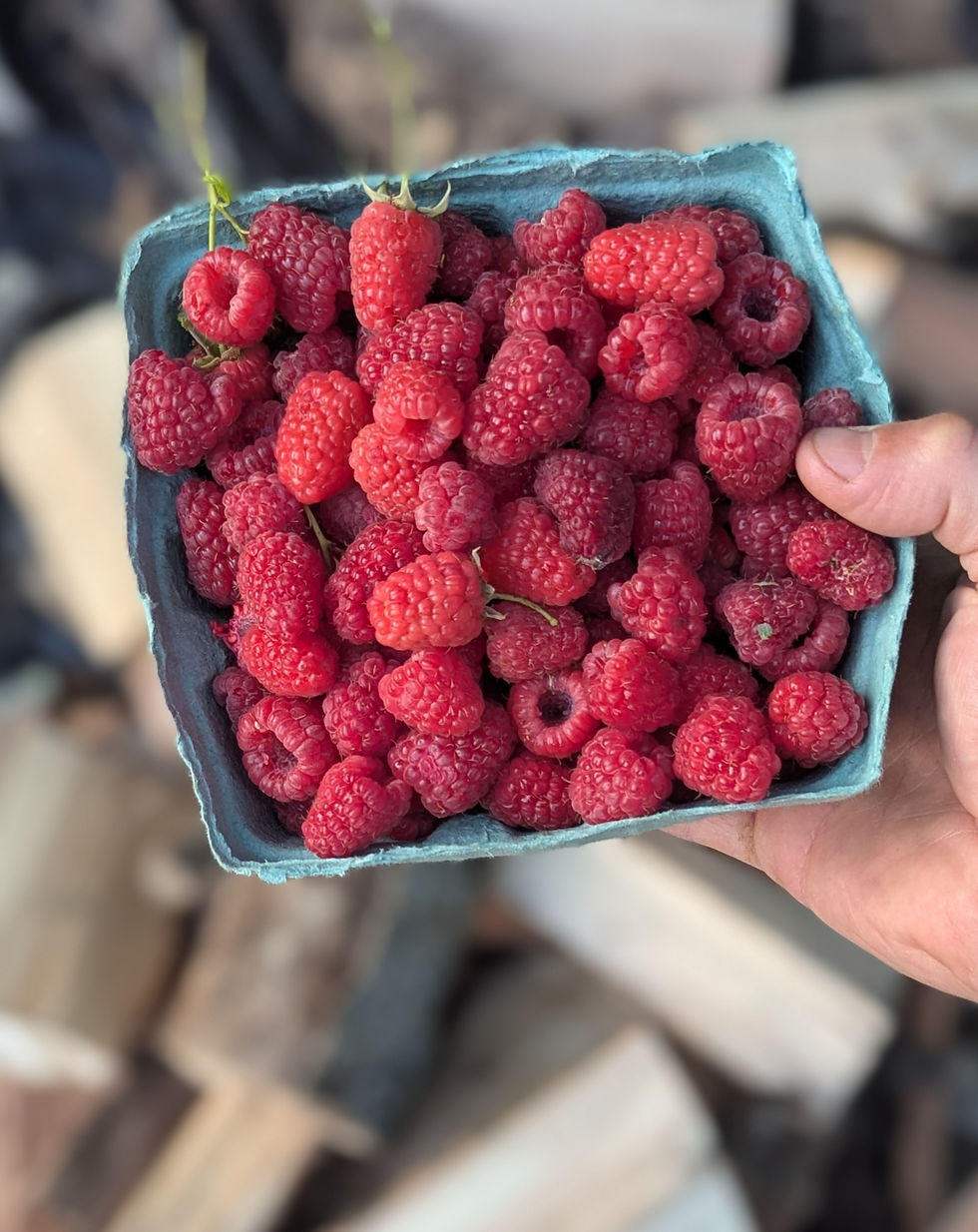
which overtakes the northern half of the garden, you just might see the furry rump of a black bear poking out of the brambles. The bear is me, and I’m wiggling the joyful dance one does when stuffing its face full of raspberries. Every afternoon in the month of July, I’m out in the thickets collecting raspberries and channeling my inner black bear, fattening up for winter. But unlike our rotund hibernator friend, we farmers just work and work, and burn all the berries right off.
We burn them off while tossing handfuls onto Papa Bean’s ice cream with a healthy glug of
maple syrup for good luck; we burn them off in yogurt and cereal and berry rhubarb tarts (and more maple syrup); we burn them off by the handful, plucked from the stem and warm from the sun. We lick the juice from our fingers and burn that off too. We also freeze them by the bag for winter, when the real hibernation begins. We dream of raspberry jam on a slab of good French bread with a strong cup of coffee on a snowy morning, followed by a novel and a woodstove….the work begins now. Freeze the berries, can the jam, chop the firewood, get tired enough to crave the lazy days of winter, so we can lie around and crave the busy days of summer. This is summertime on the farmstead.
The bats swirl around the barn when I take the dogs out at 4:30 every morning – they aim for their sliver of an entrance to the attic I’ve yet to plug up. “Good night, bats,” I say while I sip my coffee and Wilder follows a toad across the driveway with his nose, broadleaf plantain and rogue chamomile providing cover for the hopping critter. Pip stares at me stupefied, as if the bats will pick him up and fly him away. The bats poke their heads out at dusk and hope to catch a lazy dragonfly or two, maybe a mosquito or ten. “Good morning, bats,” I say, while yawning. “Have a good night.”
In the garden, I toil with weeds – persistent bindweed wrapping itself around every woody stem and bramble it can reach; smartweed in its alien-looking clumps; pennycress and dandelion and plantain and hawkweed and the list continues. Walls of goldenrod. I let the wood sorrel live under the kale like little mushrooms, to be picked when there’s fish or chicken on the menu and I need something light and lemony to toss into the butter sauce. Lambsquarter and purslane make for excellent garnishes when I’m not craving lettuce or kale. Every day I cheer on the first cucumber of my planted-too-late garden as it grows ½” a day in this drought. I daydream about the garlic scape pesto I want to spread onto this very cuke and smack my lips and tip-tap my fingers like some kind of ravenous looney tune character. The last of the raspberries, past their prime, and the first of the blackberries, still bitter and reddish, tide me over. The thorns of the raspberry canes were no match for my thick bear fur, but the violent and jagged blackberry canes loom over my head – Wilder digs a little nest in the ferns below to keep cool while I pick – and the canes draw blood on my legs and arms. Worth it for every berry. Pip is lost in the chest-high goldenrod and steeplebush jungle – he may never come out. Still....worth it for every berry.

I wrote a while back that Something Wild Farm was on a hiatus. It feels more like a sabbatical
these days. It took my ursine gallivanting among the raspberry canes to recharge my Wild. I find myself back in the soil, in the pastures, in the woods. It took pulling 500 garlics out of the ground – planted last October – and laying them in the old sheep barn to cure; suddenly I had the enthusiasm to weed 8 beds in 8 hours over one weekend so I could plant cukes, carrots, beets, and turnips for a late summer harvest. It took staring down my last five dozen golden-yolked eggs from the birds I happily gave away to order 20 more chicks for the fall, with the intention to have eggs by Christmas. It took lots of rest and sun-tanning on the back porch to realize I need to chop those dead elms down before they chop my back porch down. And what to do with all that dead elm? Wood chips, hügelkultur, and firewood. We do the work to rest and play; we rest and play to do the work. Farming is cycles, over and over again.
I play while I work. I stop for the flowers, always. I love to hold them in my calloused, dirty, stone-torn hands. Tiny bouquets find their way to kitchen counters and desks at home and work – shot glasses were meant for wild bouquets des fleurs. Is there a more invigorating spirit? Yarrow and Queen Anne’s Lace and ground nut and steeplebush and jewelweed, celandine and cinquefoil and fleabane and red clover. White clover. Stinging nettle and burdock thistle, day lily and hosta and elder flower and Joe Pye weed and meadowsweet and the occasional summertime dandelion. The last daisies. The prairie flax which grew from seed brought home from Monticello, an ancestor of flowers Meriwether Lewis took from the west. Even the tiny flowers on comfrey are lovely if you stop to notice them. I could stare into a sun-burned spent-up black eyed susan, its yellow pedals curled and falling back, its black core an endless depth of mystery, forever. I eagerly await my first sunflower of the season. They grow taller by the day, always teasing me with a bloom, but instead producing another level to its spire. I often write rhymes and verse while parading about the pastures, and repeat them over and over lest I forget:
F is for the fleurs, the petal and the stem
L is for the love with which I feel about them
E is for every fleur, of which I want to pick
U is for whom I would like to pick every fleur with
R is for rejoice! at the sight of a bouquet
S is for the bitter sweetness, when it wilts away
As intriguing as the fleurs are the spider webs pocked all over the pastures, shiny with dew in
the morning; they are fairy nests. Each one a small funnel leading into the abyss below, where a wolf spider awaits its prey. Or doth the good folk hide? They are as beautiful as flowers, as temporary and as delicate. I leave them be at all costs. Do not disrupt the little lives of the good foIk. I have a dislike, however, for the bulbous and butt-ugly orb weavers that loiter around the eaves and windowsills in their grubby little nests, and I knock them back once they are large enough to hit over a tennis net.
One spider has taken residence under my front porch light and she is calm and polite and refuses to grow any larger. She tucks herself in every morning at dawn and comes out every night after dusk. There are dozens of tiny spider babies sunning inside the glass of the light fixture. As August nights cool into the threats of September frost, I greet my mama spider friend every time I see her with the same bittersweet affection I feel for my fleurs. There will be a night soon when she no longer dangles from her thread, wrapping up a horse fly or a caterpillar that somehow found its way into her trap. I’m enamoured with the variety of dinner delights this one-inch spider manages to catch. She might eat more variety than most Americans who shop in contemporary grocery store aisles.

I while away these beat-down summer evenings working in the shade, repairing the old stone wall along the Left Pasture. I have lifted rocks I should have no business lifting. But I can lift these hundred pound monsters – and that makes it my business. Using only my body, a pry bar, and various slings and ropes, I have taught myself how to move rocks where I want them. Scratches on my arms and legs from deadlifting stones give me a quiet satisfaction as I eat copious amounts of protein to fuel my body afterward. There is no better self-help protocol than the hard work required in repairing old stone walls. If only instead of patented pills with dangerous side effects, doctors could prescribe picking raspberries, admiring flowers, lifting heavy stones, and befriending spiders.
Digging the rocks out of a century of soil is only half the work. We must now stack the wall in an aesthetic manner. “Ah, yes!” you might hear me say if you are passing by the field within earshot. I comb through my inventory with my finger on my chin. “A builder!” And clunk! I drop a stone into its new home and feel that wall settle down into itself, into the earth, for the next hundred years. Then you may hear me mutter, “Ah, balls and loaves, loaves and balls!” as I toss the junk rocks into the gaps and crevices of the single stack wall. The dogs look up from their little grassy beds in the shade, raise their eyebrows, then go back to scanning the fields for something interesting to chase. Dogs can't appreciate a good Robert Frost bit.
But then we walk out into the pasture, freshly mowed – except for the patches of clover, susans, and yarrow I leave to seed, buzzing with pollinators and dragonflies – and we admire our stone wall, which once lived as a sad jumble of fallen stones covered in hemlock saplings and ferns. It now looks much more like a farmer works these fields. He isn’t done yet, but he’s making his mark on the land. And the land is rewarding him with happiness. And the land seems pretty happy, as well.


Wow. This is stunningly beautiful, Rich! You are a word weaver who makes Mother Nature proud - I am certain of it. I'll bet the fairies feel at home on your farm, too.
My mouth was watering from your description of the raspberries, which I adore. I’ve been making raspberry peach ice cream this summer with raw cream, maple syrup, egg yolks and a pinch of salt. Next summer I might come knocking on your door for some berries.
Thanks for sharing your love of beauty in this world. You’re a wonderful writer and you evidently have met and are embodying Bear Spirit! 🐻